
Jewish Theatre, Warsaw – Two Projection Mapping Productions, Two Different Approaches
December 6, 2025
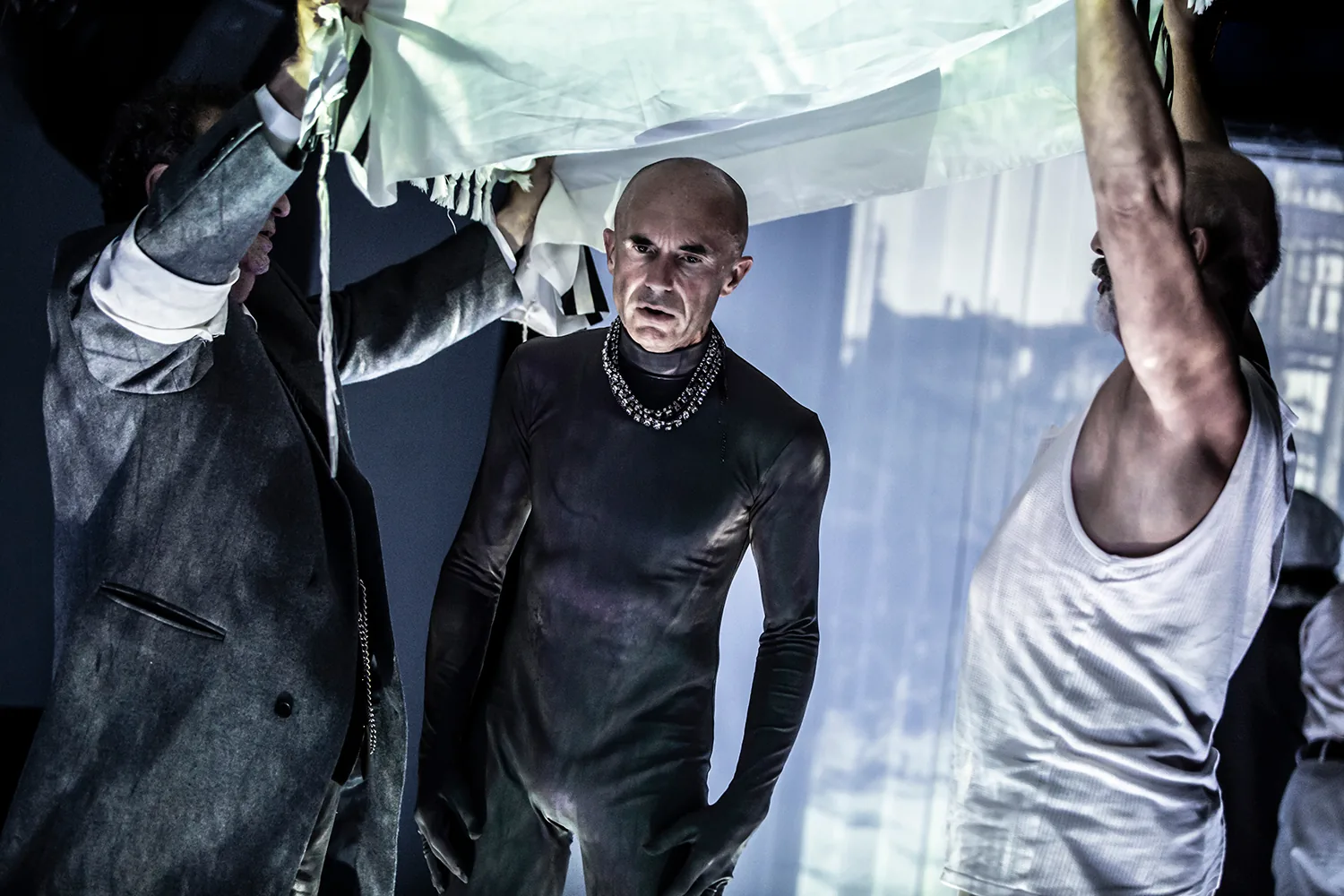
It's rare to get the chance to create two productions for the same stage in which projection plays an entirely different role. For the Jewish Theatre in Warsaw, we did exactly that: "Songs of the Ghetto," directed by Gołda Tencer, and "Dus buch fyn Gan Ejdn" ("The Book of Paradise"), directed by Damian Josef Neć. Placed side by side, they show clearly how much the scope of projection depends on the character of the source material, not on the technology itself.
"Songs of the Ghetto" — projection as testimony, not decoration
"Songs of the Ghetto" was created for the 80th anniversary of the Warsaw Ghetto Uprising — a performance combining Polish and Yiddish songs with excerpts from letters and diaries written in the ghetto. With such sensitive source material, the projection had to play an exceptionally restrained role: a subtle narrative layer built from archival material, supporting the rhythm and emotional character of the performance without ever overshadowing the live stage action or the voice of the testimonies. Jakub Zajda's lighting design and the real-time projections were built to reinforce the presence of the archival material, not to eclipse it with visual effect.
Full documentation: "Songs of the Ghetto".
"The Book of Paradise" — projection as world-building
"Dus buch fyn Gan Ejdn" was an entirely different task: multimedia plays a central role in building the narrative itself, not just its backdrop. The visual concept included virtual interpretations of King David's palace and abstract visions of paradise — shifting digital environments introducing symbolic imagery that changed dynamically as the performance unfolded. In this production, projection and lighting design extended the physical stage space, merging it with a digital environment rather than simply decorating it. Scenography was by Zbigniew Libera, the XR environment was implemented by Patrycja Superczyńska, and production photography was by Magda Hueckel.
Full documentation: "The Book of Paradise".
What both projects share despite their different approaches
Despite the different role projection played in each performance, the production process rested on the same principle: the visual layer was designed together with the lighting design as a single synchronized system, not as two separate tracks bolted together at the end — more on why this approach is essential for complex productions in our article on DMX in theatrical scenography. It's also worth reading our explanation of what projection mapping actually is as a technique.
This isn't our only collaboration with this theatre — a third production, "Der Szturem. Cwiszyn", takes yet another approach: a photogrammetric 3D reconstruction of pre-war tenement buildings from the Warsaw Ghetto used as a stage projection, accompanying texts from the Ringelblum Archive.
If you're working on a production based on archival material or a symbolic narrative that requires building an entire visual environment — let's talk about which approach fits your material.
See our projection mapping service for theatres and cultural institutions.