
How to Revive a Permanent Museum Exhibition Without Replacing the Display Cases
January 8, 2026
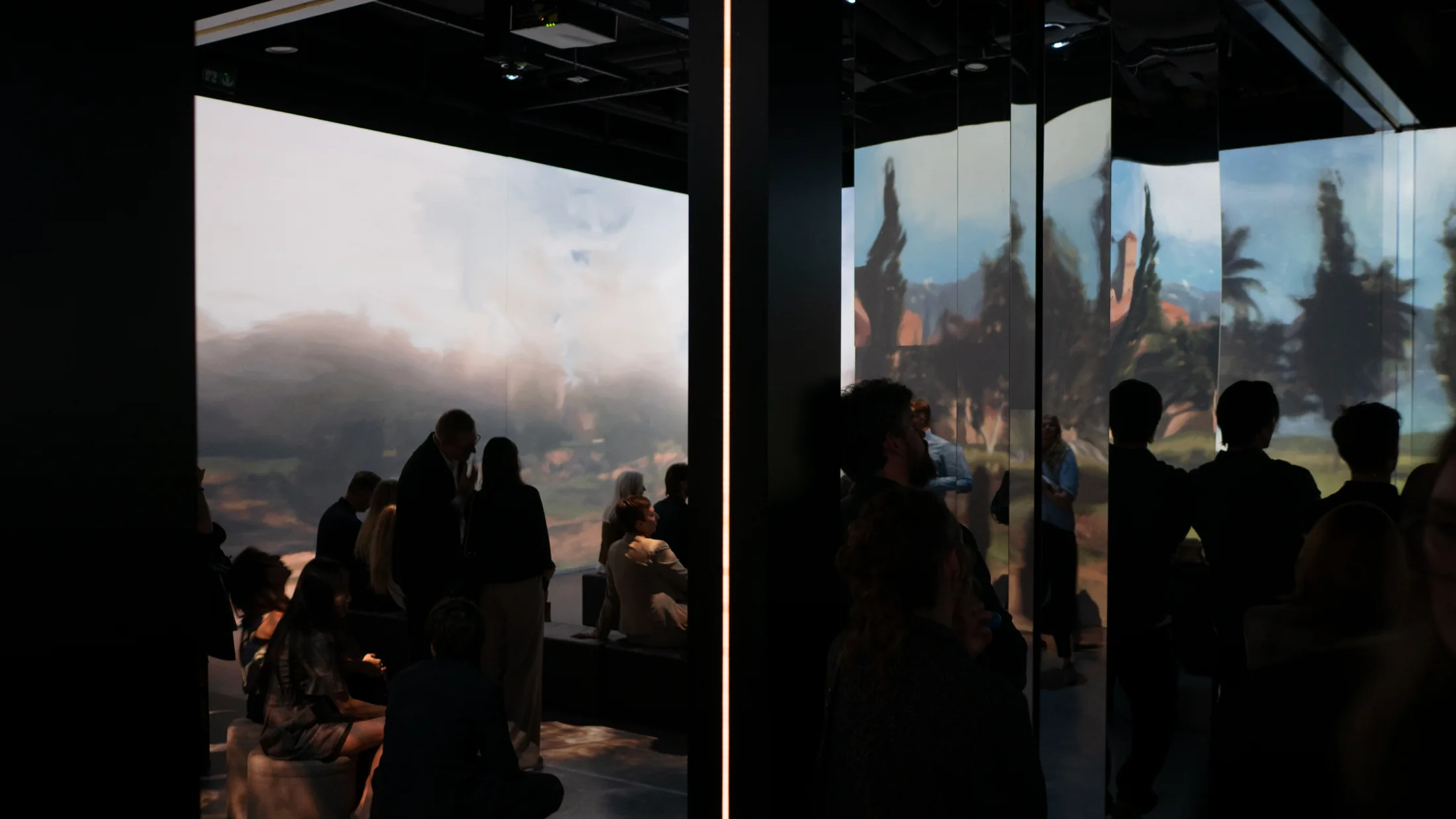
A permanent museum exhibition ages faster than its collection. Display cases, labels, and lighting from a decade ago can still showcase priceless artifacts — but to a visitor accustomed to multimedia experiences, they become invisible. The problem most cultural institutions face is this: how do you refresh how an exhibition is experienced when a full renovation of the gallery is off the table budget-wise.
The answer rarely lies in new display cases. It lies in a layer that doesn't exist yet: image, sound, and interaction overlaid on the existing space.
Why the Infrastructure Doesn't Need to Change
Projection and spatial sound work independently of whatever is standing in the room. They don't require knocking down walls or installing new display cases — they just need an anchor point: a wall, a ceiling, a floor, or the display case itself, onto which content can be overlaid. That makes modernizing an exhibition a project measured in months, not years, and it doesn't interfere with the conservation integrity of the artifacts.
In practice, this opens up several real paths:
- Contextual projection — animated backgrounds, archival material, or historical reconstructions projected on the gallery walls, building context without touching the display cases.
- A sound layer — spatial audio triggered by a visitor's presence, guiding attention without requiring long text panels to be read.
- Interactive elements — simple triggers (motion, touch, proximity) that launch additional narrative exactly where a visitor has already stopped.
When This Really Works
Immersive technologies work best where the story is stronger than the physical artifact itself — a biography, an era, an experience that's hard to convey with a label next to a display case. Our immersive animation "Romantic Chopin", shown at the Art Box Experience Immersive Gallery, grew from exactly that premise: we brought Frédéric Chopin's life and work to life through a 10-plus-minute sequence of images with a painterly, oil-like texture — instead of typical digital animation — synchronized with music and the architecture of the room. It was this visual layer, not a new display case, that carried the weight of the whole exhibition — a fact confirmed by a 2026 Webby Award in the People's Voice / Best Immersive Experience category.
The same mechanism — building the missing context where the physical artifact alone isn't enough — was also behind our VR piece "Simple Songs About Death", shown at, among other venues, the DOX Centre for Contemporary Art in Prague.
Not every exhibition needs a full VR environment. Sometimes a projection layer integrated with the existing display is enough — we write more about matching the scale of the intervention to the space in our article on XR in culture.
Where to Start
The starting point is always a space audit: the room's geometry, available mounting points, visitor flow, existing lighting. Only on that basis do we design a visual and sound layer that doesn't compete with the artifact, but strengthens it.
If you're planning to refresh a permanent exhibition and wondering whether immersive technology makes sense in your gallery — let's talk about your specific space before the scope of the investment gets decided.
See our XR experiences offer for cultural institutions.