
Projection Mapping on a Historic Facade – Is It Safe for the Building?
March 13, 2026
Before a heritage conservator approves a projection mapping show on a historic facade, they'll ask one question: what will this do to the building? It's a fair concern — and the good news is that projection mapping, unlike many other forms of intervention in public space, doesn't touch the building's fabric at all, by definition.
Is Projection Mapping Safe for Historic Buildings?
Yes — projection mapping doesn't touch the fabric of the heritage building at all. It's light cast onto a surface from a safe distance, with no drilling, gluing, or fixings on the facade. What actually needs conservation sign-off are the elements around it, like power supply or rigging, not the projection itself.
The Projection Doesn't Touch the Building's Fabric
Projection mapping is light cast onto a surface, not a fixture mounted to it. It requires no drilling, gluing, or fixings on the facade, and no intervention in the plaster, stone, or architectural detail. The entire process happens from the outside, at a safe distance — one or several projectors positioned in front of the building, with no physical contact with its surface.
What actually requires conservation oversight isn't the projection itself, but the elements around it: power supply, rigging or scaffolding for the equipment, any temporary platforms. These are worked out at the logistics-planning stage, independent of the visual content.
The Starting Point Is Always a Geometry Scan
Before any image reaches the facade, the building is thoroughly scanned or modeled in 3D. The animation is designed to precisely match every edge, cornice, and uneven plane of the facade — which means the mapping doesn't "flood" the building with image, but instead underscores its actual shape.
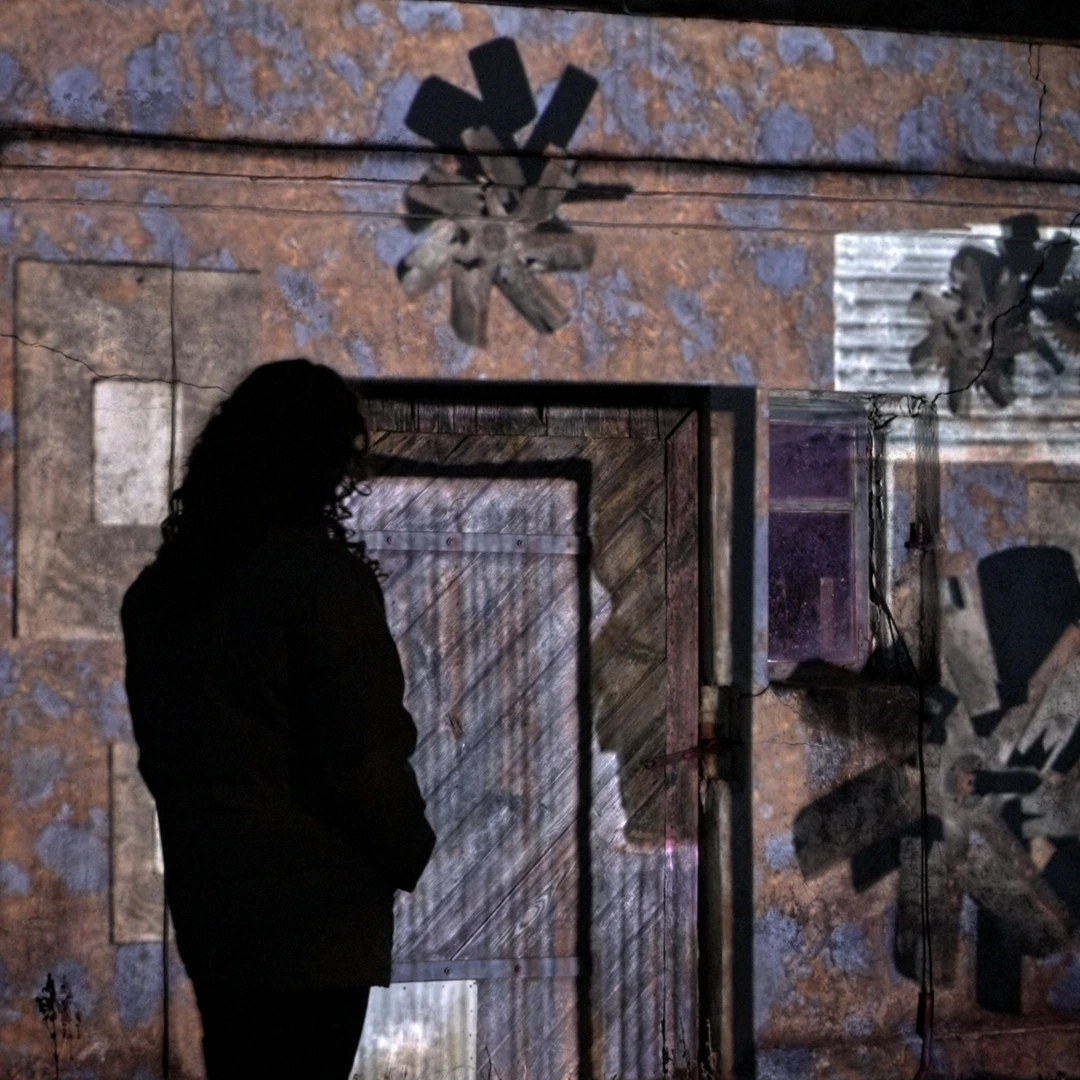
That's exactly the process behind "Rural Mapping" — a series of installations across the Polish countryside, where the starting point was capturing each object in its natural state, and the final projection was designed to "return" precisely to the place it came from, without any intervention in the often-fragile wooden structure of barns and farm buildings. We apply this same process — scanning the geometry before designing the animation — regardless of the object's scale, from a rural barn to a historic townhouse.
What's Actually Worth Settling Before Conservation Approval
- Whether the projection is temporary (for the duration of an event) or a permanent installation — these carry different formal requirements.
- What the power source is and where the equipment physically stands (always outside the building's structure).
- Whether light intensity and screening times comply with local restrictions (for example, in heritage-protection or residential zones).
For more on the technical process itself — from object scan to opening night — we cover it step by step in "Projection Mapping Step by Step".
If you're planning a projection on a building under heritage protection and need materials to support a conversation with the authorities, get in touch with us early, before you file your application.
Before you pick a studio for a project like this, see how to choose a 3D mapping company — a heritage building is not the place to experiment with an unproven contractor.
See our projection mapping service and past work on heritage buildings.